Prepaid Electricity analyzed electricity consumption patterns, smart home adoption, and search behavior related to energy savings to identify which U.S. cities are leading the way in efficiency. We also surveyed 1,000 Americans to understand how rising electricity costs are affecting household budgets and how people are responding.
Key Takeaways
- Atlanta, GA, and Orlando, FL, are the most energy-efficient cities of the cities analyzed.
- Memphis, TN; Laredo, TX; and Louisville, KY, rank as the least energy-efficient cities of the cities analyzed.
- Atlanta, GA, leads all cities in energy-saving search interest per capita (1,295 searches per 100K residents), while Enterprise and North Las Vegas, NV, show the least curiosity.
- Scottsdale, AZ, has the highest smart home density of any city in the ranking (87 smart home listings per 100K residents)
- More than half of Americans (53%) say their electricity bill is a source of financial stress.
- 1 in 4 Americans has skipped or reduced grocery spending to cover their electricity bill, and 12% have deferred a medical or dental expense.
Cities Leading and Lagging in Energy Efficiency
Energy efficiency at the city level reflects a mix of infrastructure, climate conditions, and household habits. Some communities consistently manage electricity use more effectively than others.
-
- Atlanta and Orlando are the most energy-efficient cities of the cities analyzed.
- Memphis, Laredo, and Louisville rank as the least energy-efficient cities of the cities analyzed.
Interest in Energy Savings and Smart Home Technology
Curiosity about energy conservation and the adoption of smart technology can reveal how households are adapting to rising electricity costs. Search trends and smart home listings offer a window into where efficiency is gaining traction.
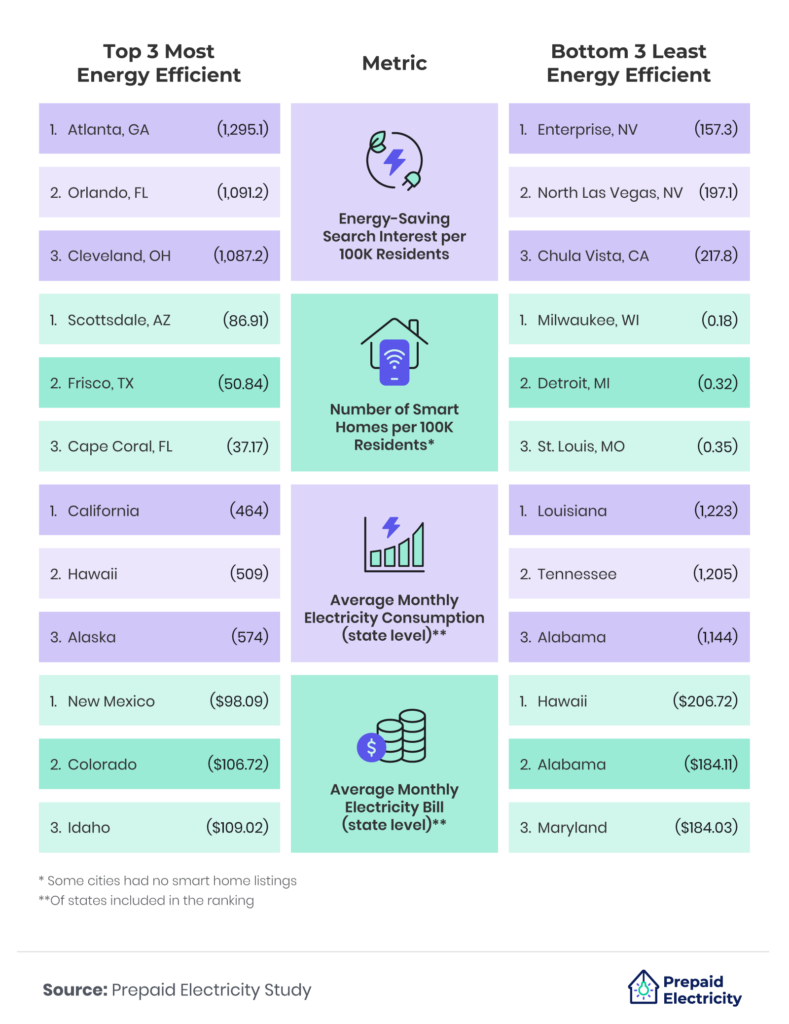
- Atlanta leads all cities in energy-saving search interest per capita (1,295 searches per 100K residents), while Enterprise and North Las Vegas, NV show the least curiosity (153 and 197 searches, respectively).
- Scottsdale has the highest smart home density of any city in the ranking (87 smart home listings per 100K residents).
- California, Hawaii, and Alaska are the most electricity-efficient states by average monthly consumption, while Alabama (1,144 kWh), Louisiana (1,223 kWh), and Tennessee (1,205 kWh) consume the most.
Rising Electricity Costs Are Reshaping Household Budgets
Electricity costs are increasingly affecting how Americans manage their household spending. The survey explored the financial pressure many families face and how those pressures influence everyday decisions.
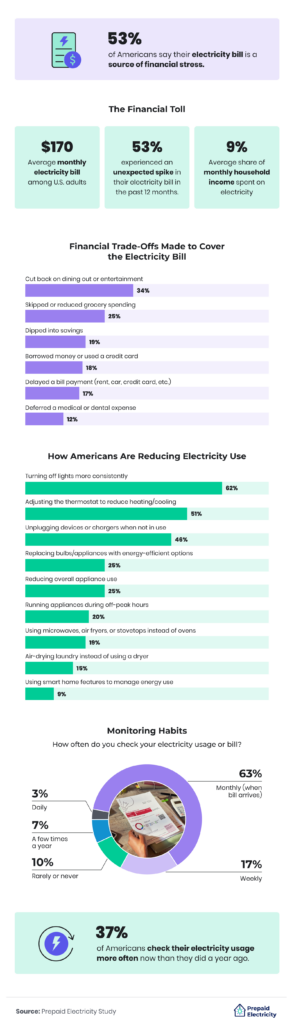
- More than half of Americans (53%) say their electricity bill is a source of financial stress.
- 1 in 4 Americans has skipped or reduced grocery spending to cover their electricity bill, and 12% have deferred a medical or dental expense.
- 51% experienced an unexpected bill spike in the past year.
- 55% of Americans currently own at least one smart energy device, with smart thermostats (25%), smart plugs (24%), smart lighting (23%), and smart appliances (20%) topping the list.
- 21% said they are likely to adopt smart home technology in the next year.
- 1 in 20 smart home device owners say their devices have noticeably reduced their electric bill, and 66% say they’d invest in energy-saving technology if they could afford the upfront cost.
- The top barrier to adoption is upfront cost (14%), followed by renting and being unable to make home changes (10%)
Efficiency Gaps Reveal Opportunities for Energy Savings
As electricity prices remain a concern for many households, understanding how cities and states compare can help consumers identify practical ways to reduce consumption and manage monthly electricity costs more efficiently.
Methodology
To identify the most energy-efficient cities in America, Prepaid Electricity analyzed 98 of the largest U.S. cities across four metrics:
- Search interest in energy-saving topics (40%): Search interest was measured using Google search volume data for energy-saving keywords from 2024 to present, normalized per 100,000 residents to account for differences in city population.
- Smart home device adoption (35%): Smart home adoption was measured using the number of smart home listings on Zillow per 100,000 residents, with five cities missing listing data (Saint Paul, MN; Anchorage, AK; Newark, NJ; Santa Ana, CA; Huntsville, AL) filled using the dataset average for the ranking.
- Average monthly electricity consumption (20%): Average monthly electricity consumption and average monthly electricity bill were estimated using state-level residential electricity data from the U.S. Energy Information Administration (EIA, 2025). Monthly consumption per customer was derived by dividing total annual residential electricity sales (million kWh) by the number of residential customers, then dividing by 12.
- Average monthly electricity bill (5%): Average monthly bill was derived by dividing total annual residential revenue by the number of residential customers, then dividing by 12. Both figures were applied at the state level, meaning all cities within the same state share the same consumption and bill estimates.
Each metric was normalized to a 0–100 scale using min-max normalization before scoring. For monthly electricity consumption and bill, lower values indicate better energy efficiency and were scored accordingly; a rank of No. 1 in either metric reflects the lowest usage or cost in the dataset. City population estimates are sourced from the U.S. Census Bureau Vintage 2024 estimates.
Limitations: Because consumption and bill data are available only at the state level, cities within the same state receive identical scores for those two metrics; individual city-level variation is not captured. Smart home listing data was unavailable for five cities, so the dataset average was used as a neutral placeholder. Search interest reflects curiosity and awareness about energy-saving, but does not directly measure behavior. Zillow listings may change regularly. Rankings should be interpreted as a composite index of energy-efficient signals rather than a definitive measure of household energy efficiency. The ranking is limited to the cities analyzed, not all cities in America.
We also conducted a survey of 1,000 Americans to explore attitudes and behaviors regarding electricity costs, including bill-monitoring habits, energy-saving behaviors, smart-home device ownership, and perceptions of financial stress related to electricity spending.
About Prepaid Electricity
Prepaid Electricity makes it easy to get power on your terms. With no credit checks, no deposits, and same-day connections, you’re in control from the start. We work with trusted providers to give you simple, affordable prepaid electricity plans plus daily balance alerts so there are never any surprises. Getting started is fast, easy, and stress-free.
Fair Use Statement
This content may be shared for noncommercial purposes only. If referenced or reused, please provide proper attribution and include a link back to Prepaid Electricity.